

Florida insurance agents must understand more than policy coverage and insurance terminology. They also need to know the state laws and regulations that govern how insurance is sold, how consumers are protected, and what responsibilities agents have after becoming licensed.
That’s why Florida insurance laws are an important part of the state’s insurance licensing exams. Whether you’re preparing for the Florida 2-20 General Lines exam, a life and health insurance exam, or another state licensing exam, understanding Florida-specific regulations is essential.
The good news? You don’t need to memorize the entire Florida Insurance Code. You need to understand the laws relevant to your license, recognize important legal concepts, and know how to apply them to situations you might encounter as an insurance professional.
Here’s what to focus on and how to make studying Florida insurance law more manageable.
What Florida Insurance Laws Are Covered on the Agent Exam?
Florida insurance licensing exams test candidates on state laws, regulations, and professional responsibilities. The specific topics and number of questions depend on the license you’re pursuing, but insurance exams often focus heavily on state-specific laws.
According to the Florida insurance examination content outlines published by Pearson VUE, state-specific topics can include:
- Licensing and appointments: Who can legally sell insurance, licensing requirements, and the distinction between being licensed and appointed.
- Agent responsibilities: Fiduciary duties, handling premiums, recordkeeping, and reporting requirements.
- Unfair trade practices: Prohibited sales activities, misrepresentation, fraud, twisting, and other deceptive practices.
- Consumer protections: Required disclosures, policyholder rights, and applicable cancellation or replacement rules.
- Regulatory oversight: The responsibilities of Florida’s insurance regulatory agencies.
- Continuing education and compliance: Requirements for maintaining an insurance license and complying with state regulations.
Not every topic applies equally to every license. For example, someone preparing for a Florida Property and Casualty insurance exam will encounter different product-specific laws than someone studying for a Life and Health insurance exam.
Study tip: Before you begin reviewing Florida insurance laws, download the official Florida Insurance Examination Content Outlines and find your specific exam. These outlines identify the subjects you need to know and help you prioritize your study time.
Who Regulates Insurance Agents in Florida?
Understanding Florida’s insurance regulatory structure is an important part of exam preparation.
Two state agencies play particularly important roles:
Florida Department of Financial Services (DFS)
The Florida DFS, through its Division of Insurance Agent and Agency Services, oversees agent licensing, appointments, education requirements, and certain compliance and disciplinary matters.
Florida Office of Insurance Regulation (OIR)
The OIR regulates insurance companies and certain insurance-related activities, including insurer financial oversight and insurance rates and forms, as authorized by law.
The distinction matters because licensing exams may ask which agency has authority over a particular issue.
For example, a question about an agent’s license or appointment generally points toward DFS, while a question about insurance company rate regulation generally involves OIR.
Knowing which agency handles which responsibilities can help you eliminate incorrect answers on exam questions.
Florida Insurance Laws Every Agent Candidate Should Understand
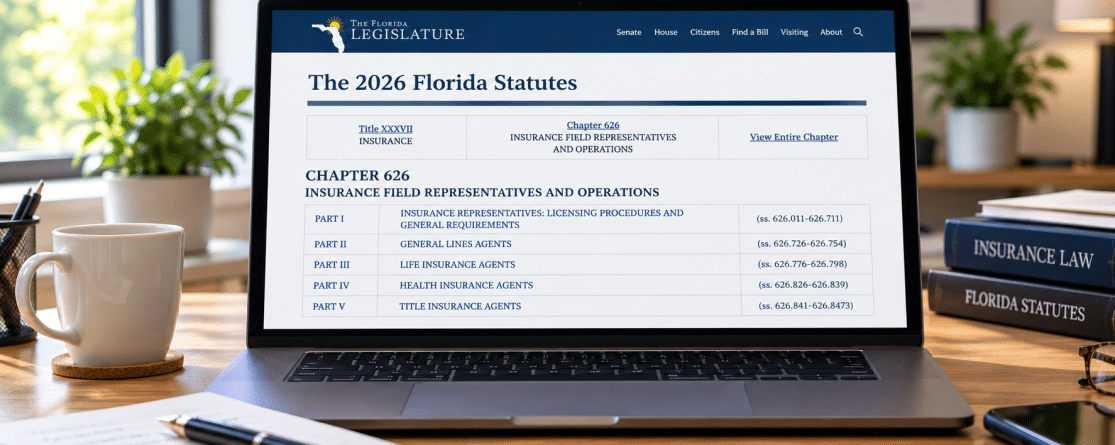
Florida’s insurance laws are primarily in Title XXXVII of the Florida Statutes, including Chapters 624 through 651.
For insurance agents, Chapter 626 is especially important because it addresses licensing, agent responsibilities, and unfair insurance trade practices.
Here are several areas worth understanding before exam day.
1. Licensing and Appointment Requirements
Under Florida Statute 626.112, insurance agents generally must be both properly licensed and appointed to act as insurance agents.
These are two different requirements.
A license establishes that an individual meets the state’s qualifications for a particular insurance role. An appointment authorizes the individual to act on behalf of an appropriate appointing entity.
An exam question might describe someone who has received a license but has not yet obtained the required appointment. Understanding the distinction helps you determine whether that person is authorized to conduct the insurance activities described.
2. Unfair Insurance Trade Practices
Florida prohibits unfair and deceptive practices in the insurance industry.
Chapter 626, Part IX of the Florida Statutes addresses unfair insurance trade practices, including activities such as:
- Twisting: Using misleading representations or comparisons to improperly induce a policyholder to replace or change an insurance policy.
- Churning: Using an existing policy’s values to finance another policy in circumstances prohibited by Florida law.
- Misrepresentation: Making false or misleading statements about insurance policies or benefits.
- Sliding: Including or charging for additional insurance products or coverages without the required informed consent.
- Unfair discrimination: Treating individuals or risks differently in ways prohibited by insurance law.
- Rebating: Offering inducements related to insurance purchases outside what Florida law permits.
These concepts are especially important because exam questions may describe a sales situation without naming the prohibited practice.
For example, instead of asking you to define twisting, a question might describe an agent making misleading comparisons to persuade a customer to replace an existing policy.
Understanding the behavior behind each term is more useful than memorizing the definition alone.
3. Agent Ethics and Fiduciary Responsibilities
Insurance agents have professional responsibilities involving honesty, fair dealing, and the proper handling of money.
Florida law includes requirements related to premium funds, recordkeeping, compensation, and accountability.
One important concept is fiduciary responsibility. Insurance agents who receive premiums or other funds in their professional capacity have legal obligations regarding how those funds are handled and accounted for.
For exam preparation, focus on recognizing situations involving an agent’s responsibilities to customers, insurers, and regulators.
4. Consumer Protections, Disclosures, and Policy Changes
Florida insurance law includes protections intended to help consumers understand their coverage and make informed decisions.
Depending on the license you’re pursuing, your exam may address:
- Required policy disclosures
- Insurance advertising standards
- Policy replacement requirements
- Cancellation and nonrenewal provisions
- Grace periods and free-look rights
- Claims-related requirements and consumer protections
Be careful not to assume that one rule applies to every insurance product.
For example, cancellation requirements for a homeowners policy may differ from those governing life or health insurance. The same is true of replacement disclosures and other consumer protections.
Exam tip: Pay attention to the type of insurance policy described in each question. A correct answer for one line of insurance may not apply to another.
How Florida Insurance Laws Differ by License Type
Although Florida insurance licensing exams share some general legal concepts, the state-specific material varies by license.
| Florida license | Examples of legal topics to study |
|---|---|
| 2-20 General Lines | Agent responsibilities, property and casualty regulations, unfair trade practices, and policyholder protections |
| 4-40 Customer Representative | Customer representative authority, permitted activities, agent supervision, and applicable property and casualty rules |
| 2-15 Life, Health & Variable Annuity | Life and health regulations, disclosures, replacements, annuity requirements, and consumer protections |
| 2-14 Life | Life insurance and annuity laws, beneficiary provisions, replacements, and sales practices |
| 2-40 Health | Health insurance regulations, required provisions, disclosures, and applicable consumer protections |
This is why using Florida-specific exam preparation materials matters. A general insurance textbook may explain policy concepts but may not adequately address the laws tested on your particular Florida exam.
How to Study Florida Insurance Laws for Your Exam
Insurance laws can be one of the more challenging parts of exam preparation. There are unfamiliar terms, regulatory distinctions, and rules that may seem similar at first.
Rather than trying to memorize everything at once, use a structured approach.
Start with the official exam outline
The Florida Department of Financial Services directs candidates to the official examination content outlines.
Review the outline for your license and identify the Florida statutes, rules, and regulations sections.
Use those sections as your study checklist. The outline helps you distinguish the topics you need to know from legal details that aren’t relevant to your exam.
Study legal concepts using real examples
Understanding how a law works makes it easier to remember for the test, but insurance exams often take it a step further. They create and phrase questions to ensure you not only know a concept, but can apply it in real-world scenarios.
For example, rather than simply asking for the definition of misrepresentation, the exam may ask what happens when an agent incorrectly describes policy coverage to convince someone to buy insurance.
Ask yourself:
- What did the agent do?
- Which law or ethical responsibility applies?
- Why is the conduct prohibited?
- What should the agent have done differently?
This approach can help you recognize the same legal concept when it’s presented in an unfamiliar exam question or as an everyday scenario.
Learn the differences between similar terms
Some Florida insurance law concepts are easy to confuse, especially if you’re new to insurance and/or when you’re studying several at once.
Twisting, churning, sliding, and rebating are all related to insurance sales practices, but they describe different activities and have distinct legal requirements.
Create a comparison chart that identifies the meaning of each term and includes a short example. This is especially helpful for scenario-based questions where several answers initially seem plausible.
Use practice exams to identify weak areas
Practice questions are useful for more than measuring your overall readiness.
When you miss a question about Florida insurance law, review the explanation and identify why you selected the wrong answer.
Was it a misunderstanding of the law? Did you confuse two regulatory agencies? Did you overlook a detail about the type of insurance policy involved?
Keep a list of the concepts you miss repeatedly and return to those topics before your next practice exam.
Review Florida-specific material throughout your training
Don’t leave all the state law material until the end of your course.
Mix Florida-specific legal questions into your regular study sessions. Repeated exposure can help you retain important definitions, responsibilities, and regulatory distinctions.
A few minutes reviewing legal concepts throughout the week can be more effective than trying to memorize an entire section the night before your exam.
Florida Insurance Law Exam FAQs
Do Florida insurance licensing exams include state-specific laws?
Yes. Florida insurance licensing exams include state-specific statutes, rules, and regulations relevant to the license being tested. The subjects and weighting vary by exam. Candidates should review the official Pearson VUE examination content outline for their license.
Do I need to memorize Florida insurance statutes to pass?
You should understand the laws, terminology, and requirements identified in your exam outline. Some questions may require knowledge of specific rules or legal details, but you don’t need to memorize the entire Florida Insurance Code. Focus on the topics your exam covers (listed in the content outlines) and practice applying them to realistic situations.
What Florida insurance law is most important for agents?
Chapter 626 of the Florida Statutes is particularly relevant because it covers insurance representatives, licensing requirements, agent responsibilities, and unfair trade practices. Other chapters and administrative rules may apply depending on the type of insurance license.
Are Florida insurance laws the same for property and casualty and life and health agents?
No. While certain general rules apply across multiple license types, Florida has additional laws and requirements for specific lines of insurance. Property and casualty candidates and life and health candidates should study the content outline for their respective exams.
How often do Florida insurance laws change?
Florida insurance laws and administrative rules can change through legislation and regulatory updates. Candidates should use current study materials and check official Florida DFS and Pearson VUE resources for the requirements applicable to their exam. Choosing a trusted course provider can also be an asset, as any good training partner should be on top of the most recent changes and updates to state insurance laws.
Understanding Florida Insurance Laws Beyond Exam Day
Learning Florida insurance laws isn’t just about earning a passing score. It’s also about understanding the responsibilities you’ll have when working with real customers.
Agents need to recognize prohibited sales practices, provide appropriate disclosures, handle insurance transactions correctly, and understand when state regulations affect their work.
Those responsibilities don’t end when you receive your license.
Florida also requires many insurance licensees to complete continuing education, including applicable Law and Ethics update courses. The requirements depend on the license type.
Building a solid foundation in Florida insurance law during your initial training can make it easier to understand future regulatory changes and maintain compliance throughout your career.
Prepare for Your Florida Insurance Exam with All-Lines Training
Florida’s insurance laws may seem complicated at first, but the right preparation can make them easier to understand.
At All-Lines Training, our Florida insurance licensing courses are designed to help you learn the insurance concepts and state-specific regulations relevant to your license. Instead of trying to piece together information from multiple sources, you can follow a structured training program that helps you prepare for your exam.
Whether you’re studying property and casualty insurance, life and health insurance, or customer representative responsibilities, understanding Florida’s laws is an important step toward becoming a knowledgeable insurance professional.
Explore our Florida insurance agent training options and find the course that fits your licensing goals.